

Do you ever eat a full meal and still feel the urge to keep eating? Do you find yourself standing in front of the refrigerator at midnight, searching for something you cannot name? Do you crave specific foods like chocolate, chips, or ice cream when you are stressed, bored, or lonely? If you answered yes to any of these questions, you may be struggling with emotional eating. And you are not alone.
Emotional eating is not a sign of weakness. It is not a lack of willpower. It is not a character flaw. It is a coping mechanism that you learned somewhere along the way. Perhaps as a child, you were given food to soothe you when you were crying. Perhaps as a teenager, you turned to food when you felt lonely or misunderstood. Perhaps as an adult, you discovered that eating provided a temporary escape from the pressures of work, family, and life. That lesson was not a moral failure. It was survival. You did what you had to do to get through difficult moments. But now that coping mechanism is no longer serving you. It is keeping you stuck in a cycle of shame, restriction, and bingeing. And it is time to learn a new way.
This article will help you identify the five signs that your eating is emotional, not physical. You will learn to distinguish between hunger that comes from your stomach and cravings that come from your brain. You will discover the biological and psychological mechanisms behind emotional eating. And you will learn a simple, compassionate framework to break the cycle of emotional eating forever. This is not about willpower. It is about understanding.
Sign 1: You Eat When You Are Not Physically Hungry
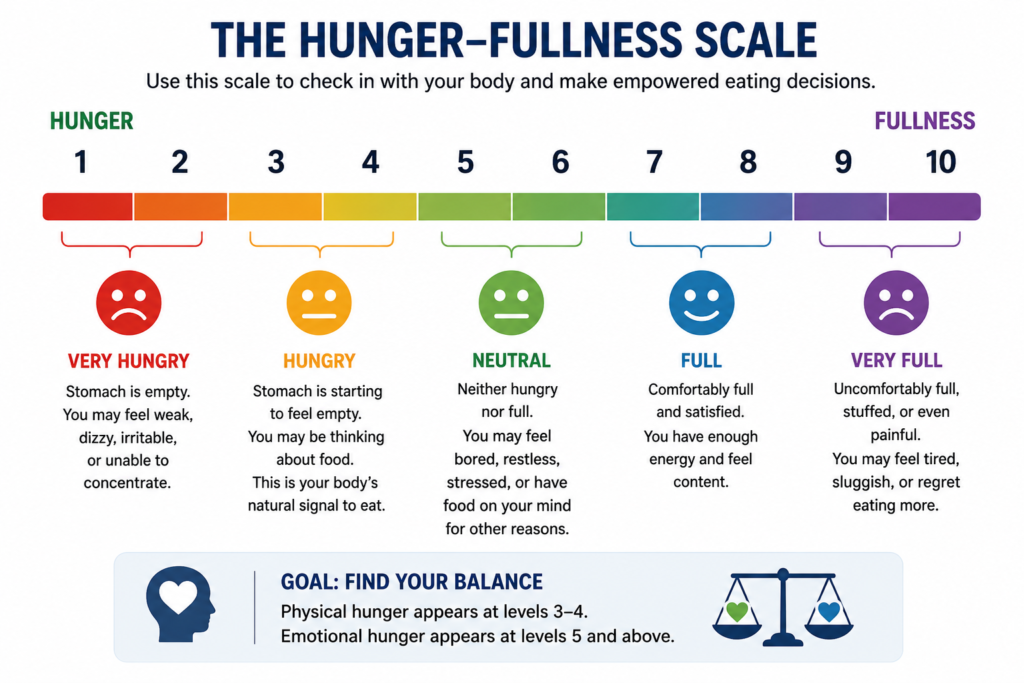
The first and most obvious sign of emotional eating is eating when you are not physically hungry. Physical hunger is a biological signal. It comes from your stomach. It builds gradually over time. You can feel it coming. You can wait to eat. Your stomach may growl. You may feel empty or lightheaded. You may have trouble concentrating. Almost any food sounds good because your body needs fuel. This is your body’s natural, healthy way of telling you that it needs energy.
Emotional hunger is different. It comes from your brain. It appears suddenly, often in response to a trigger. You may have had a stressful day at work. You may have had an argument with your partner. You may be feeling bored, lonely, or tired. Suddenly, without warning, you have an intense craving for a specific food. Not an apple. Not a salad. Chocolate. Cookies. Chips. Ice cream. Pizza. The craving feels urgent, almost desperate. It feels like you will not be okay until you eat that specific food.
Here is a simple test you can use right now. Rate your hunger on a scale from one to ten. One means you are starving, weak, dizzy, and unable to concentrate. Ten means you are stuffed, uncomfortable, painfully full, and wish you had stopped eating earlier. Physical hunger typically appears at level three or four. You are hungry, but not desperate. You could eat, but you could also wait. Emotional hunger appears at level five or higher, even when your stomach is full. You are not physically hungry, but you feel a strong urge to eat.
| Hunger Level | Physical Sensation | Emotional State | Recommended Action |
| 1-2 | Starving, weak, dizzy, unable to concentrate | Desperate, panicked | Eat immediately |
| 3-4 | Hungry, stomach empty, thinking about food | Ready to eat, calm | Good time to eat |
| 5-6 | Neutral, neither hungry nor full | Bored, restless, stressed | Pause and check in |
| 7-8 | Full, satisfied, comfortable | Content, relaxed | Stop eating |
| 9-10 | Stuffed, uncomfortable, painful | Ashamed, guilty, overwhelmed | Stop eating sooner next time |
If you are eating at level five or above, you are not physically hungry. You are eating for another reason. The first step to breaking emotional eating is simply noticing this difference. Do not judge yourself. Do not shame yourself. Just notice. Awareness is the foundation of all change. You cannot change what you do not see.
Sign 2: You Crave Specific Comfort Foods
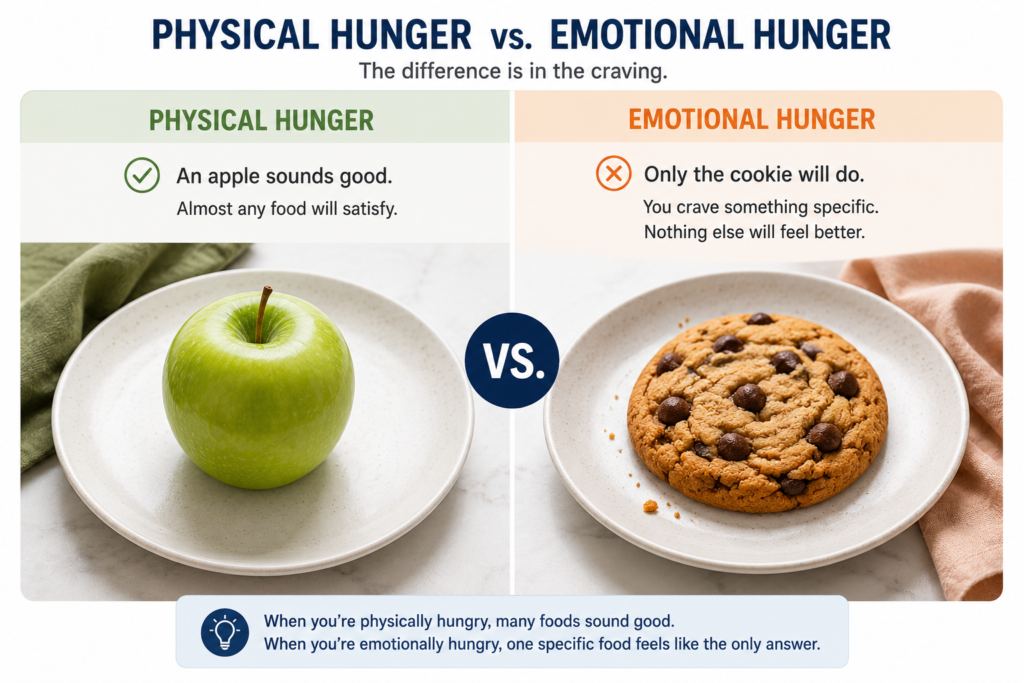
The second sign of emotional eating is craving specific foods, usually what psychologists call “comfort foods.” These are typically high in sugar, fat, or salt. Chocolate, ice cream, cookies, cake, chips, pizza, macaroni and cheese, bread, pasta, fried foods. These foods trigger the release of dopamine, the feel-good neurotransmitter. They provide a temporary sense of pleasure, relief, and comfort. This is not an accident. Your brain is wired to seek out these foods because, from an evolutionary perspective, they provided concentrated energy that helped your ancestors survive.
Physical hunger is not picky. When you are truly hungry, almost any food sounds good. You would eat an apple, a banana, a piece of chicken, a handful of nuts, a bowl of rice. Your body needs fuel, and it does not care much about the source. Emotional hunger demands a specific food. It is not satisfied by an apple. It wants the cookie. It wants the chips. It wants the ice cream. This is because emotional hunger is not about fuel. It is about feeling.
When you crave a specific comfort food, ask yourself: What am I really craving? Not the food. What feeling am I trying to get? Are you craving comfort? Are you craving distraction? Are you craving a moment of pleasure in an otherwise stressful day? The food is not the need. The food is an attempt to meet a need. Once you identify the real need, you can find other ways to meet it. Not with food. With action.
Sign 3: You Eat in Response to Emotions, Not Stomach Signals
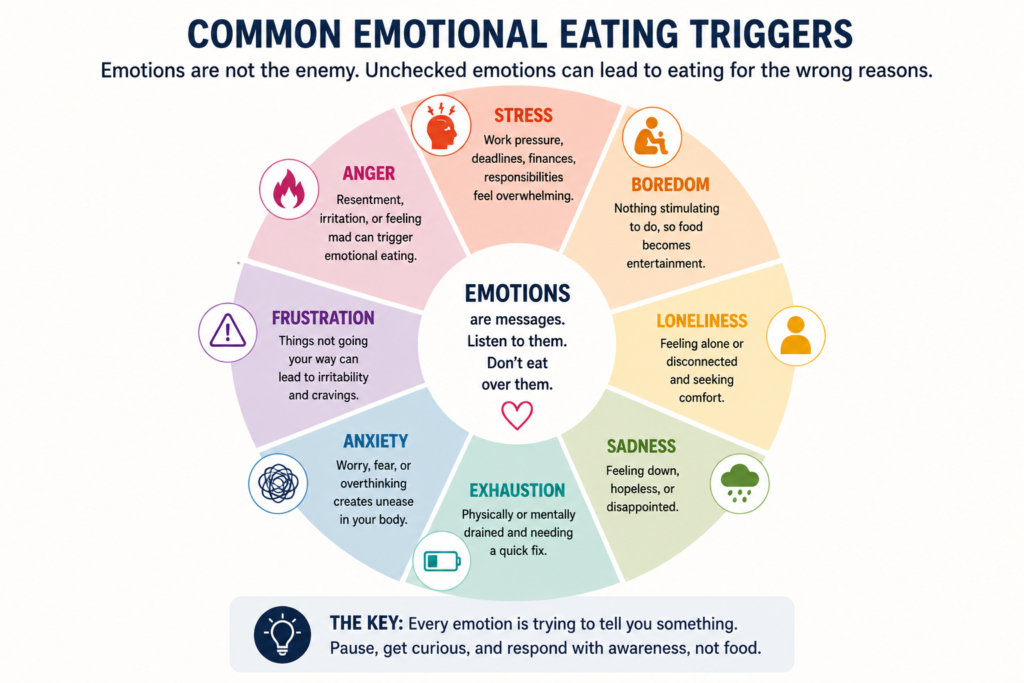
The third sign of emotional eating is that your eating is triggered by emotions, not by stomach signals. You eat when you are stressed. You eat when you are bored. You eat when you are lonely. You eat when you are angry. You eat when you are sad. You eat when you are exhausted. Some people even eat when they are happy, using food to celebrate or reward themselves. Food has become associated with emotion, not with hunger.
The key question is: What came first? The emotion or the hunger? If you are physically hungry, the hunger came first. You feel hunger in your stomach. Then you eat. If you are emotionally eating, the emotion came first. You feel stressed, bored, or lonely. Then you feel the urge to eat. The emotion is the trigger. The food is the response.
Here is a simple exercise. Keep a trigger log for one week. Every time you feel the urge to eat, pause. Take three deep breaths. Write down the time of day, what you are feeling, and what happened in the hour before. Do not judge. Just write. At the end of the week, look for patterns. Do you always eat when you are stressed? Do you always eat when you are lonely? Do you always eat when you are watching television? Do you always eat at a certain time of night?
These patterns are clues. They are the key to breaking the cycle. Once you know your triggers, you can make a plan. If you eat when you are stressed, you can plan to take a walk or do deep breathing instead. If you eat when you are bored, you can plan to call a friend or read a book instead. If you eat when you are lonely, you can plan to join a community or reach out to a loved one instead. You are not powerless. You have options.
Sign 4: You Eat Mindlessly or Automatically
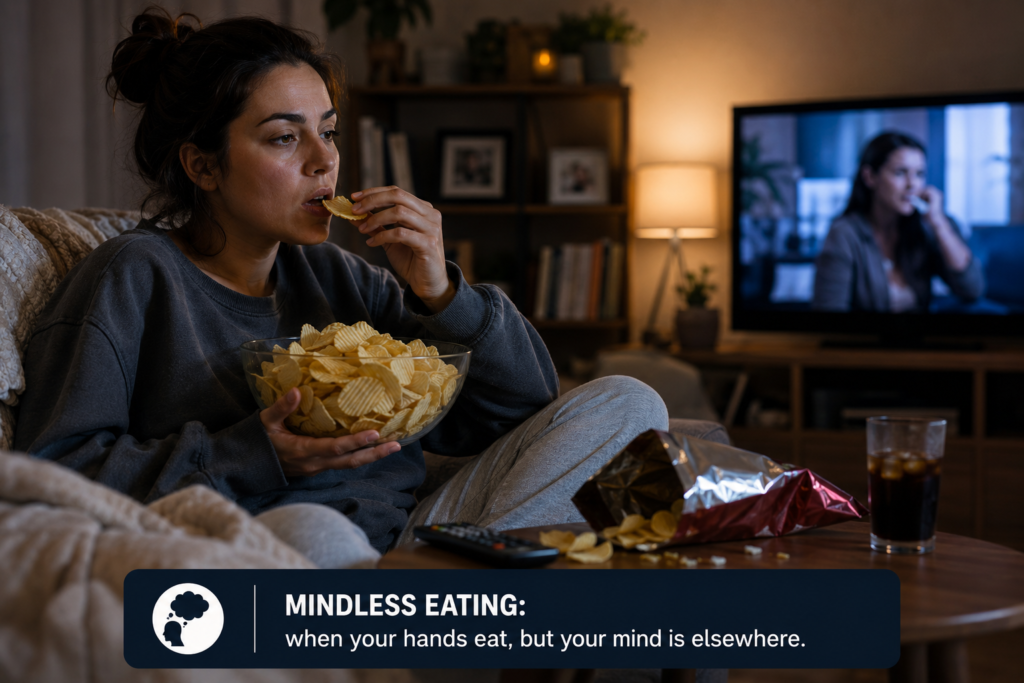
The fourth sign of emotional eating is that you eat mindlessly or automatically. You do not taste the food. You do not remember eating it. You look down and the bag is half empty or completely empty, and you do not even remember opening it. You eat while watching television. You eat while scrolling through your phone. You eat while driving. You eat while working at your computer. You eat while standing in front of the refrigerator. Your hands are eating, but your mind is elsewhere.
Mindless eating often happens when you are distracted. Your attention is divided. You are not present. You are not enjoying the food. You are just consuming. This is not a moral failure. It is a habit. Your brain has learned that certain cues lead to eating. The cue might be sitting on the couch. The cue might be the start of a television show. The cue might be the feeling of boredom or stress. The cue might be a certain time of night. The cue triggers the routine of eating. The routine leads to a reward, which is the temporary relief from the uncomfortable feeling.
Physical hunger is usually accompanied by mindful eating. You taste the food. You enjoy it. You notice when you are getting full. You stop when you are satisfied. Emotional hunger is often mindless and automatic. You are not eating because you are hungry. You are eating because it is a habit. The good news is that habits can be changed. You do not need to use willpower to resist. You need to understand the habit loop and replace the routine.
Here is how to break the mindless eating habit. First, identify the cue. What triggers your mindless eating? Is it sitting on the couch? Is it watching television? Is it a certain time of night? Is it feeling bored? Write it down. Second, identify the reward. What are you getting from eating? Is it relief from boredom? Is it comfort? Is it distraction? Write it down. Third, choose a new routine that provides the same reward. If you eat because you are bored, find another activity that relieves boredom. Read a book. Call a friend. Do a puzzle. Knit. Play a game on your phone. If you eat because you are stressed, find another activity that relieves stress. Take a walk. Do deep breathing. Stretch. Listen to music. Fourth, practice the new routine repeatedly. It will take time to become automatic. Be patient. Be consistent.
Sign 5: You Feel Guilty or Ashamed After Eating
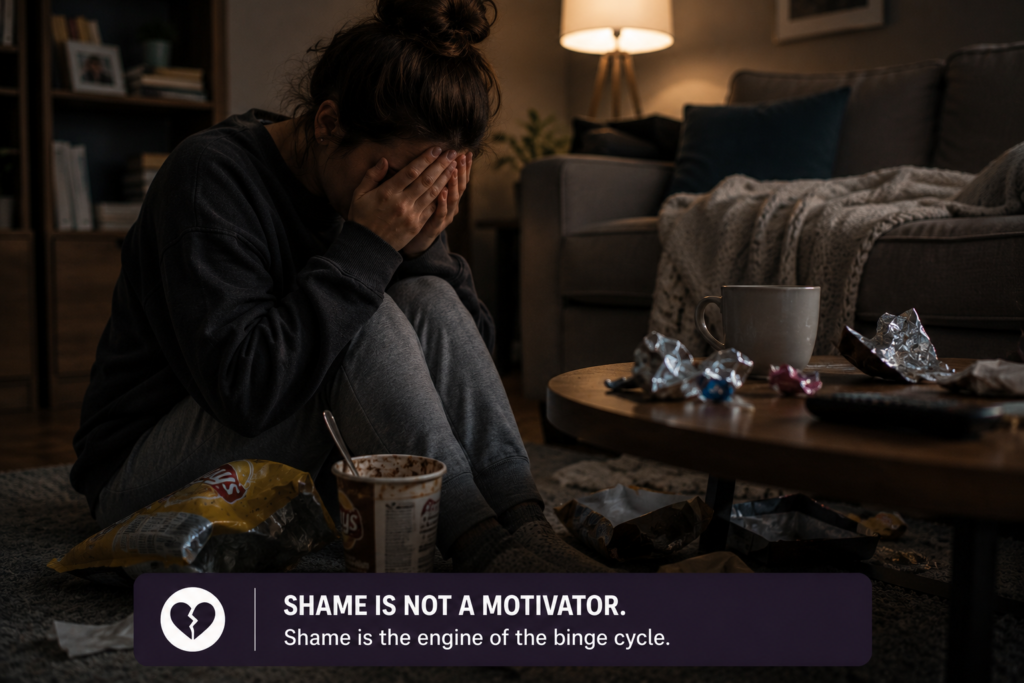
The fifth and most painful sign of emotional eating is feeling guilty or ashamed after eating. You eat the food. You feel a moment of relief, a brief escape from whatever you were feeling. Then the shame hits. It washes over you like a wave. You tell yourself that you have no willpower. You tell yourself that you ruined your diet. You tell yourself that you are weak. You tell yourself that you are a failure. You promise to do better tomorrow. You promise to start again on Monday. And then the cycle repeats.
Here is the truth that no diet book tells you. That shame is not helping you. It is making you worse. Shame triggers the stress response in your body. Cortisol rises. Your heart rate increases. You feel anxious, irritable, and overwhelmed. And what do you do when you feel those things? You eat. You eat to feel better. The shame leads to more eating. The more eating leads to more shame. The shame-binge cycle continues. Shame is not the solution. Shame is the problem.
Physical hunger does not come with shame. When you eat because you are truly hungry, you feel satisfied. You feel good. You have given your body what it needs. There is no guilt. There is no shame. You simply ate, and now you are no longer hungry. Emotional eating often comes with shame because you know that you are not eating for the right reasons. You know that you are eating to escape, to numb, to distract. But the shame is not the answer. The answer is self-compassion.
Self-compassion is treating yourself with the same kindness you would offer a friend. If a friend told you that she ate a whole pint of ice cream because she was stressed, what would you say to her? Would you call her weak? Would you tell her she has no willpower? Would you shame her? Of course not. You would say, “It is okay. You are human. Tomorrow is a new day.” You deserve that same compassion. You are not a failure because you ate emotionally. You are a human being who is struggling. And struggling is not a sign of weakness. It is a sign that you are trying.
The Pause Practice: A Tool for Breaking Emotional Eat
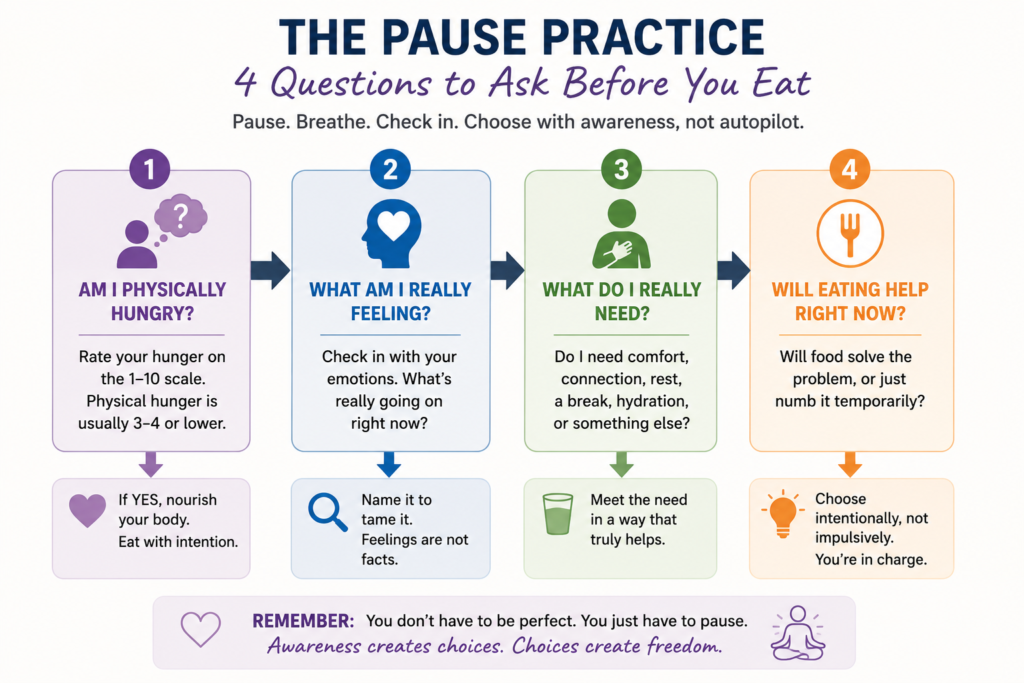
Now that you know the five signs of emotional eating, what can you do about them? The most powerful tool is the Pause Practice. It is simple. It takes less than one minute. It costs nothing. And it can save you from hours of shame and bingeing.
When you feel the urge to eat, pause. Do not get up from your chair. Do not walk toward the kitchen. Do not reach for food. Just pause. Take three slow, deep breaths. Inhale for four counts. Hold for four counts. Exhale for six counts. The longer exhale activates your parasympathetic nervous system, calming your body and mind.
Then ask yourself these four questions:
Question 1: Am I hungry or am I feeling? Rate your hunger on the scale from one to ten. If you are at level three or four, you are physically hungry. Eat. If you are at level five or above, you are likely feeling something. Proceed to question two.
Question 2: If I am feeling, what am I feeling? Name the emotion. Boredom? Exhaustion? Loneliness? Anger? Stress? Anxiety? Sadness? Do not judge. Just name it. Naming the emotion reduces its power over you.
Question 3: What do I really need right now? Not food. What do you really need? Boredom needs engagement. Exhaustion needs rest. Loneliness needs connection. Anger needs expression. Stress needs relief. Sadness needs comfort. Identify the real need.
Question 4: What is one small thing I can do instead of eating? If you are bored, call a friend, read a book, do a puzzle, clean a drawer, listen to a podcast. If you are exhausted, take a nap, go to bed early, lie down and close your eyes, drink a cup of tea. If you are lonely, text someone you love, join a support group, pet your animal, go to a coffee shop. If you are angry, write a letter, punch a pillow, scream into a void, go for a fast walk. If you are stressed, take deep breaths, stretch, go for a walk, take a break. Do that one small thing. Then check in. Do you still want to eat? Maybe. Maybe not. Either way, you have done something important. You have paused. You have asked. You have chosen. You are not on autopilot anymore.
Why This Matters for Your Weight Loss Journey
Emotional eating is not a side issue. It is the main issue. If you do not address the feelings that drive you to eat, you will continue to struggle. You can have the perfect diet plan. You can count every calorie. You can exercise every day. You can lose weight. But if you are eating your feelings, you will gain it back. The feelings do not go away. They are still there, waiting to be felt. And when they resurface, you will eat again. The cycle will continue.
Your body is not broken. Your willpower is not weak. You do not have an eating problem. You have a feeling problem. You have been using food to do a job it was never meant to do. Food provides energy and nutrients. It does not provide comfort, safety, love, or connection. It cannot fill the void left by unmet emotional needs. Only you can do that. By learning to feel your feelings without feeding them. By learning to give yourself what you actually need. By learning to be with yourself in discomfort without running to the refrigerator.
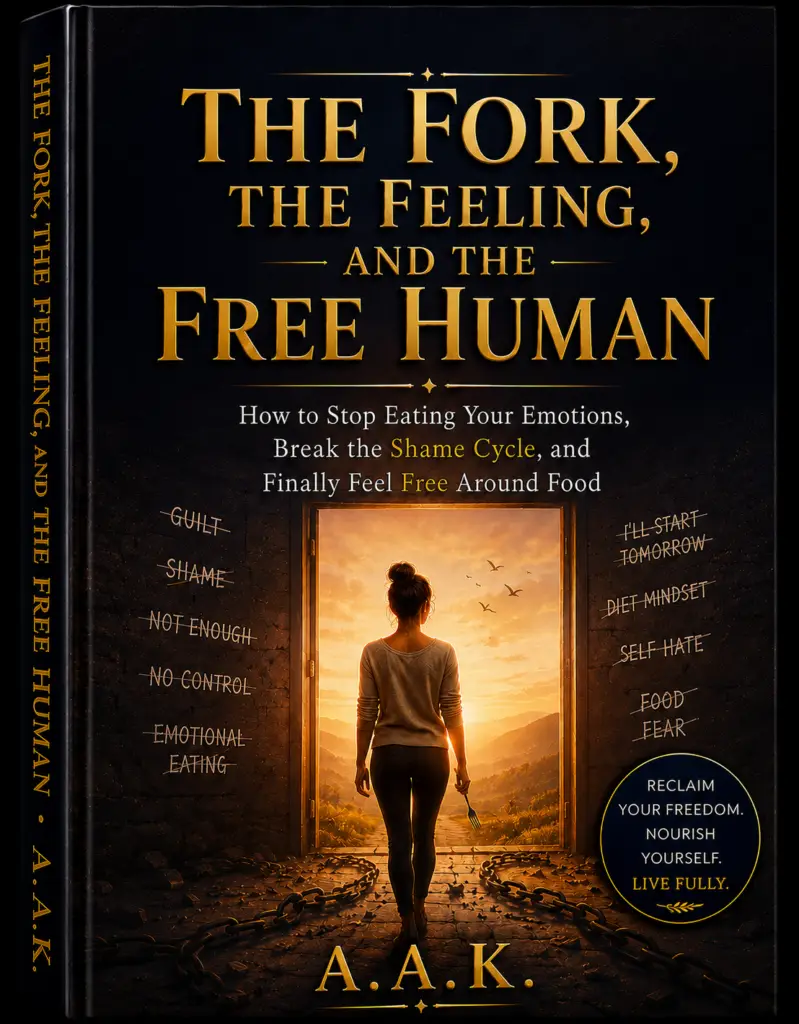
The Fork, The Feeling, and The Free Human is not a diet book. It is a freedom book. It will teach you to name the emotion beneath the craving, pause before you eat, and give yourself what you really need. No calorie counting. No meal plans. No shame. Just a simple, compassionate framework to break the cycle of emotional eating forever.
If you are tired of fighting a war against your own body, this book is your peace treaty. Stop feeding your feelings. Start feeling them. And finally become free.
Summary Table
| Sign | What It Looks Like | What to Do |
| 1 | Eating when not physically hungry | Rate your hunger on the 1-10 scale |
| 2 | Craving specific comfort foods | Ask: What am I really needing? |
| 3 | Eating in response to emotions | Keep a trigger log to identify patterns |
| 4 | Eating mindlessly or automatically | Identify the cue and replace the routine |
| 5 | Feeling guilty or ashamed after eating | Practice self-compassion, not shame |
Call to Action
Do you recognize yourself in these five signs? You are not alone. Millions of people struggle with emotional eating. And most have been told that the problem is their willpower. It is not. You are not weak. You are not broken. You have a feeling problem. And there is a solution.
The Fork, The Feeling, and The Free Human will teach you a better way. Click the link below to get your copy and start your journey to freedom.
Buy The Fork, The Feeling, and The Free Human today